For my fourth and last SAMO, my family went to the Smart Art Museum, to see a gallery focused on identity. To be perfectly honest, it was okay. I didn’t really connect with a lot of the art, and there was a few that I liked, but there was really only one piece I really connected with. It was also, coincidentally, the first piece of art about butches, which is probably why I connected with it.
I honestly went into seeing the painting in a very skeptical light but I blame that on my mom, who read the plaque that stated it was from a series called Self-Portraits & Dykes, lightly jogged across the exhibit to where I was looking at something else and very loudly proclaimed “Elise, there’s a dyke painting!”, to which I had to explain to my mom that dyke is a slur (which, somehow, she wasn’t previously aware of).
Self-Portrait/Nursing by Catherine Opie
Anyways I walked up to it and immediately had several thoughts, “this is weird”, and “this is probably more acceptable to straights” being the biggest ones. Both are admittedly very weird thoughts but they were there, so I had to take a bit and think about where they came from.
I found out two things from this introspection:
I thought it weird was because I had never considered the possibility of butches wanting to be, or actually being a mother. My perception of butch and motherhood were just fundamentally opposed to each other and to a degree, it still is (yay for internalized homophobia!)
The lady in the painting is the epitome of a Big Bad Lesbian. She had the word pervert tatted on her chest in white ink and just oozes that dyke energy the church hates so much, and yet I genuinely believed that she would be more acceptable to straight people. My mom, who heard the word dyke so much she didn’t know it was a slur and is banning me from wearing a tie to graduation, said she liked the painting.
All of this was definitely because of the baby. This woman, branded a “pervert”, looking at an infant with absolute love and adoration was just that powerful. It made her seem useful and therefore acceptable, which I readily acknowledge is both ignorant and homophobic. Overall, the whole experience was weird as hell and raised a lot of questions I straight up can’t answer.
Like, does my dyspohria possibly have anything to do with why I saw butchness/motherhood as opposites? Was I attributing my lack of desire for children onto my sexuality without realizing it? Do other people do that to me? If I, a butch woman, can look at that painting and think/feel all sorts of homophobic stuff, what do straight people think when they look at it? What do straight people think when they look at me and learn that I don’t want kids? Do people think the same stuff when they learn a straight woman doesn’t want kids? What about a non-butch queer woman? Why/how have I been socialized to believe that sexuality has to be useful in order to be valid? How, when, and why did that idea even become a thing?
I don’t have any answers, and It’s possible I’ll never have them.
It doesn’t take a genius to notice that mass incarceration is a serious but overwhelming issue. It is designed, enforced, and upheld by nearly every level of government from individual police officers to the Supreme Court. It disproportionately sweeps thousands of impoverished people of color into a second class status for doing something that white folks are just as likely to do but very rarely penalized for. It strips them of their humanity, their right to participate in our democracy, and their right to government aid, public housing, and a steady job. This deliberately perpetuates their poverty and the system is designed in such a way that this poverty is further punished and folks who have served their time will likely end up in jail immediately after their release. In other words our government has deliberately created a “justice system” that punishes trivial drug use in almost exclusively vulnerable communities, effectively punishing thousands for inheriting misfortune.
It might seem like there’s nothing you can do to make a difference but there are several organizations out there fighting the good fight, and several things you can do to make a difference. A very simple but effective way to get started is to post some statistics on social media and raise awareness! This is highly encouraged, but if you want to go a step further, check out The Sentencing Project.
The Sentencing Project is a small nonprofit research and advocacy center based in Washington, D.C that is dedicated to raising awareness and supporting legislation that addresses the ineffectiveness and severity of our penal system in addition to addressing demographic disparities in the criminal justice system. They mainly work to produce nonpartisan research that can be used by policymakers and journalists, which are published and open to public access on their website.
Headed by Marc Mauer, author and leading expert in his field on incarceration and prison form, and staffed by lawyers, academics, and practitioners, The Sentencing Project has already made a difference. They often testify before Congress, Senate, U.S. Commissions, and various scholarly or government meetings to inform policymakers and the public. They provide invaluable support to reform focused legislation and work directly with politicians on the federal, state, and local levels. They participated in a national, bipartisan coalition focused on sentencing reform and helped pass the Fair Sentencing Act which reduced the penalty for crack cocaine (which is disproportionately used in poor communities) compared to powder cocaine to address demographic disparities in our penal system.
You can support The Sentencing Project by donating and signing petitions or contacting representatives, or by simply exploring and learning from their media platforms and sharing their content with your followers.
How To Donate
Scroll down and fill in the form.
How To Sign Petitions or Contact Representatives
Scroll down to a section called “Current Action Items”. This is where you can get information on legislation that The Sentencing Project is currently pushing for. In general there are usually about 2 action items, where you can contact your representatives or sign a petitions.
For petition based action items it will take you to a page. Click the blue button that says “sign this petition”. It will take you to another page where it shows you the petition which has already been written for you! Scroll down and fill your name, email address, and location, and click the blue button below that says “Sign The Petition”.
For representative based actions, clicking on the “Take Action Now” button will open up a small tab. Simply fill the blanks, scroll down, and click the grey button that says “Take Action”. Again, the letter has already been written for you, although this time you can directly edit the letter and directly tell your representatives what you think.
Get Connected
The Sentencing Project has several media platforms and a free newsletter you can subscribe to. The content includes new and engaging material that you can share with your followers, from research findings to live footage of government meetings and speakers. The links are below.
As soon as I began researching our Criminal “Justice” System I very quickly had to redefine my definition and mental representation of criminality. I had known for a very long time that African Americans were more likely to be incarcerated for drug crimes, and that non-violent drug offenders made up the majority of the prison population, but had chalked it up to misconception that poverty breeds crime and that black people were simply more likely to be poor. That all came crashing down very quickly, along with several other misconceptions that completely changed my mental framework regarding justice, criminality, and the penal system.
From a young age we are brought up to believe a criminal is one or both of two things. A young violent gangster who was a casualty of poverty or a violent monster that ruins lives and is unfit to live in society. This socialization is done through things such as implicit racism, the locals news, crime shows, etc. On the local news we are flooded with stories of young black men in an orange jumpsuit serving their time, and on cop shows we see horrifically inaccurate forensic units break the law to enforce the law. Their violation of the rules (search without warrant, breaking and entering, etc.) is presented as cool and necessary to apprehend countless rapists and murderers who would have otherwise continued to terrorize innocents.
This socialization is so complete that the first result from Google Images when I search ‘Criminals’ is a tatted-up ex-Crip turned model nicknamed the “hot felon”. A lot hotter than the stereotypical criminal, but a good example nonetheless, Jeremy Meeks was arrested at 18 for violently assaulting a 16 year old boy. The other results were of scary ripped men covered in tattoos. This isn’t concerning at first glance but if we dig a little deeper we learn that Google Images uses a super accurate algorithm that shows us internet content based on prevalence and context. Which means that Jeremy Meeks and others likes him overwhelmingly represents the public perception of a criminal.
Convict Jeremy Meeks, and also the first Google Images result when I look up the word ‘criminal’. This ex-crip was arrested at 18 for violent assault of a 16 year old boy, and pretty neatly reflects what the average person imagines when they hear the word ‘criminal’.
Additionally, there is very little information that is accessible and mainstream that accurately represents what prison is like. As a result, we’re effectively blinded from the context of Justice in America. Most importantly, we are blind as to A) what the average criminal is like, and B) what jail looks like. This blindness allows us to dehumanize criminals and ignore the horrors they face in prison, and prevents us from having a productive discussion about criminal justice. After all, who wants to advocate for a criminal like Jeremy Meeks? (Hint: Nobody).
So if Jeremy’s isn’t the typical criminal (both physically and mentally), how do we get an accurate picture of the face of crime? Well, the first thing we have to realize is that under the law, someone convicted for simple possession of marijuana on school grounds is just as much a felon as the guy convicted for violent crimes like 1st degree murder, rape, arson, etc. They get the same punishment, and are placed in the same conditions, and while the latter might be facing multiple life sentence, the former is still in jail long enough to ruin their lives and is now significantly more likely to be convicted again.
Though Blacks and Hispanics represent approximately 30% of the population, they comprise over 50% of the incarcerated population.
POC are much more likely to face stopped and searched, arrested, convicted, and face harsher penalties for white even when severity of crime is controlled for.
65% of prisoners haven’t finished high school, and 14% have less than an eight grade education.
Over 1/3 of the prison population has received public assistance.
13% grew up in foster care.
10% experiences homelessness a year prior to entering prison.
In February 2019, 81.8% of state and local arrests were for drug law violations.
Almost two thirds (64.5 percent) of the inmate population meets the medical criterion for a substance abuse disorder. (7x greater than the general population)
One third (32.9 percent) of inmates have a mental health disorder.
A quarter (24.4 percent) have co-occurring mental health and substance use disorders.
Just 27 percent of inmates in the entire prison/jail population are free of a substance abuse or mental health disorder.
52.2 percent of redivists are involved with drug law violations.
Only 11 percent of inmates with substance use disorders receive any type of treatment during incarceration; few of those receive evidence-based care.
(The video above is an interview/conversation set up between kids and felons. It’s really humanizing and a rare opportunity to see ex-convicts outside of the usual context of guilt/crime/danger we are used to seeing.)
Demographically, the average criminal is a young impoverished black man struggling with addiction and/or mental illness, incarcerated for a non-violent drug offense. Which means that the average criminal is young, relatively innocent, and suffering. Which means the U.S. Government has effectively and deliberately chosen to criminalize mental illness, poverty, the effects of which are amplified in communities of color. When we consider the fact that drug task forces are almost exclusively enforced in ghettos even though white people are just as, if not more likely to abuse drugs as a black person, we can also come to the conclusion that our justice system has also criminalized being a racial minority.
In other words our government has deliberately decided to criminalize suffering, rather than extending a helping hand and helping them when they need it most.
What is Jail Like?
For those who haven’t seen Orange Is The New Black (which you should totally watch), it’s hard to comprehend what jail means for its inhabitants. We might realize intellectually, that it isn’t a good place to be. After all, incarceration is meant to be a punishment. But few of us can grasp how punishing our system really is.
There’s a lot of places to start with this, but I think the best are food and physical environment, simply because those are two things that really determine the quality of my day outside of activities/social interaction.
The physical environment is generally…lacking. You’re given a 6×6 cell with no windows. You share it with a roommate. Your mattress if flat, your blanket is itchy. Your room is torn up at random intervals by guards looking for contraband. Everything is depressing.
Generic prison cell.
The food is worse. There are tons of scandals, like the time inmates had to deal with maggots and mice falling into their food and apparently this is pretty common. An inmate on 60 minutes, where prisoners anonymously described prison food recalled that,
“The worst meal I ever acquired in jail was beans. That was literally the entire meal. Beans with disgusting little wormy looking maggot things in it, served with raw uncooked onion and a tiny piece of over-dry corn bread.
That was a dinner meal, and if you chose not to eat it, then you typically went hungry for 14 hours until breakfast the next morning. For me, the meal was so bad, that I started skipping it for dinner and starving myself until breakfast the next morning. It was literally inedible for me.”
(Here’s a link to the full episodes of their show 60 Days In, where inmates regularly leak prison secrets)
In addition, sexual assault, torture, and beatings occur regularly at the hands of fellow inmates and prison guards, and it is well known within the field of psychology that the experience of prison is a traumatic one that strips feelings of autonomy and safety and results in hypervigilance and emotional overcontrol.
Solitary Confinement, for example, is literally torture. As in pretty much every qualified person in the field of ethics, psychology, criminal justice, and other related fields has come to the consensus that solitary is an extremely traumatic experience and a brutal violation of basic human rights. It is commonly used by gaurds and can be used for pretty much any reason. Stuff that will get you in solitary includes being violent, being in a gang, talking back to a guard, being caught with a minor violation (such as contraband which can includes stuff like food and candy, or even talking to a suspected gang member among other things.
In solitary, inmates are locked within a cell and deprived of human contact for 22 hours a day. Access to rehab or educational services is cut, you cannot communicate with your family, medical and mental health treatment is grossly inadequate, and in some cases you will be tortured by guards (sexual assault, being bound in “Stress positions” which tear joints and stretch nerves, being beat up, being deprived of food, etc.) It is disproportionately used against minority groups including people of color, LGBTQ+ folks, and the mentally ill. The experience can and will produce the following symptoms, some of which are permanent:
Hypertension
Headaches
Migraines
Profuse sweating
Dizziness
Heart palpitations
Extreme weight loss
Abdominal pain
Visual and auditory hallucinations
Hypersensitivity to noise and touch
Insomnia and paranoia
Distortions of time and perception
Increased risk of suicide
PTSD
Disrupted thinking
Paranoia
Nightmares
Phobias
Memory loss
Lethargy
Hostility
Poor impulse control
Hopelessness
Mood swings
Withdrawal
Self harm
Depression
Anxiety
Feelings of uncontrollable rage or despair
Many of these symptoms persist after solitary confinement, and the experience can even trigger the development of mental illness or worsen a pre-existing mental condition, driving people to suicide.
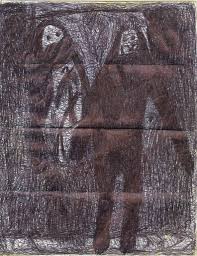
Untitled, by Ernest Jerome Defrance. The piece was inspired by his time in Solitary.
Another example of abuse is that it is apparently common practice in many states to shackle the ankles of women giving birth and have the guards watch the entire birthing process…It’s commonly acknowledged that giving birth is quite literally a physically and emotionally traumatic event even in hospitals surrounded by loved ones, and many women who go through this develop PTSD-like symptoms.
“While I was incarcerated I miscarried at five months pregnant,” she says. “They shackled me to the bed and left me to lay there for several hours with my deceased baby stuck between my legs. My lifeless baby was unable to fully abort and I was left lying there hopeless and helpless. I will never be able to erase that memory.
They continued the inhumane treatment keeping me shackled the whole time I was transported and treated at the hospital. I could feel them yanking and pulling, and still hear the sound of my deceased baby dropping into a metal bucket. Still shackled, I was returned to the jail, put back into my cell, not the infirmary.”
Miscarriages are alarmingly common in prison, and highly associated with emotional distress. In addition, there are even cased of inmates giving birth in solitary confinement or being refused a midwife and having to go through the whole process on their own.
A Bureau of Justice Report found that sexual assault rates are increasing and that nearly half (40 percent) of sexual assault allegations implicated prison staff.
For the record, It only took me about 15 minutes of research to come across all these human rights violations. I can’t imagine what I would find if I kept searching.
Within the concept of our socialization, none of this matters because the framework allows us to justify the status quo and guarantees our compliance with the current system. As a result, we become apart of the problem. A cog in a system that takes members of our society that are suffering or lashing out from a lifetime of abuse, and throws them into a system that strips them of their autonomy, dignity, humanity, safety, and family. The system brands them with the label criminal, blocking them from receiving housing, funds from public assistance programs like welfare, civic participation like voting, thousands of jobs, decreases their likelihood to get a job, or a house, and puts them under a system of supervision meant to sweep them back into the system of abuse if they so much as falter.
But these misconceptions are fallible. The knowledge that incarceration is basically a giant amalgamation of the abuse of basic human rights, brutal torture, and grossly substandard living conditions makes us question the ethics of incarceration. And while it is possible to ignore this predicament, it is much harder to do so when we consider the fact that thousands of so-called criminals are not irredeemable menaces to society, but rather people who are struggling to secure a life of quality in the face of brutal systemic barriers.
We can no longer chalk up these abuses to the unforgiving hand of justice, because if we look at the facts, this simply isn’t justice. And if this is “justice”, within the context of American values, then we must ask ourselves if our concept of justice is something we really ought to value in the first place.
Ask yourself what justice should look like after staring into the face of crime.
Do you believe vulnerable groups should be criminalized for trivial offenses that are rarely enforced in privileged populations? Do you believe criminals deserve to be treated as real human beings? Do you care about the lives of criminals? Or are you satisfied with the way things are?
The illusion of Justice is made by a great number of things, but the most powerful aspect goes by many names. The Just World Fallacy. Bootstrapping. Meritocracy. The American Dream. It is a cognitive bias that makes us want to believe that the world is fair and people get what they deserve. It’s a nice thought and doesn’t sound very harmful at first. Except, this means that every single person on Earth is subconsciously inclined to rationalize injustice-although the effect tends to be significantly stronger in those who do not face injustice. This sets the scene for manipulation of public perception, a radio for the broadcast of illusory justice.
It is the political philosophy that certain things like goods/money/power should be vested in individuals on the basis of talent, effort, and achievement. It is a foundational theme of American culture, that at first glance sounds perfectly reasonable.
However, it is logistically flawed because it operates under the assumption that “merit” is the sole determining factor of success. It fails to take into account what so-called “merited individuals” have in the way or heredity, wealth, privilege, resources, and connections, of lack thereof. It also operates under the assumption that the distribution of power exists in a void and acts independently from human cognitive bias. This philosophy bars systematically oppressed people from holding power in our society and deprives them of opportunity. Even more damaging, it sends the message that the success of minorities is a byproduct of altruistic charity from the elite and that they haven’t “earned” their lot in life. This sends the message that minorities are simply undeserving of success.
Political cartoonist B. Deutsch
An injustice that Rankine mentions talks about this directly. In it, a white woman tells a black person that while she wanted her son to go to a specific university, he wasn’t accepted because of affirmative action and seems upset. Not only does she assume that her son was qualified in the first place, but she also assumes that her son’s failure was due to a minority receiving undeserving aid. She fails to consider the idea that the college might have found an equally or more merited individual, and acts as if her son was entitled to his chosen education and that’s denial was a clear injustice. The black person did not reply, and even wondered if they were supposed to apologize.
In Post-Racial America, this illusion is stronger than ever and it can be incredibly difficult to have a conversation about identity and privilege when not only are people naturally inclined to believe they are deserving, but conversation regarding success and identity are often regarded as rude or charged, and looked down upon in the majority of social settings. But a conversation must be had, because the only way to cast aside the illusion is for a massive shift in consciousness to take place where we can be forthright and honest with ourselves. Where we acknowledge that we are all “privileged at birth, and ascribed access to options and opportunities, often without realizing it.” At the same time we must keep in mind that privilege doesn’t necessary undermine a person’s success, but rather that the privileged exist within a system that facilitates, even expects, success. We must also force ourselves to acknowledge the other, uglier, side of the coin. That the underprivileged exist within a system where they are largely barred from opportunity and expected to fail, or where their success is predicated by exceptional fortune or merit. That the vast majority of people, if not everyone, cannot honesty claim that we completely deserve everything we have in life.
This conclusion is a worthy piece of discussion that could single handedly shape the way in which we as a society interact with other groups, institutions, laws, traditions, etc, but for some it can be the most disturbing concept they have ever considered. SImply put, the illusion is a justification. It is a potent antidote to the sting of guilt or the byproduct of a lifetime of socialization and political propaganda. Regardless of why we believe the illusion, we are all able to maintain it because it is convenient. It allows us to ignore target groups and turn a blind eye to a seemingly herculean system that strips the “other” of their identity, dignity, humanity, consistently questions their right to exist in a capacity society deems unconventional, and establishes the foundation for a pattern of horrendous prejudice and discrimination-a system we profit from and have no incentive to acknowledge. A system that is perfectly satisfied with our feelings of denial, helplessness, or mere indifference.
Political cartoonist Ann Telnaes
This is what Margaret Wheatley’s “Willing To Be Disturbed” attempts to convey. That the system’s existence persists because we understand not to understand. Because we eagerly and naturally bury the impacts of our social identities and actively emphasize the individual to the point that it undermines our ability to see blatant examples of human suffering. When what we should be doing is trying our best to listen to target groups and piece together the fragments of their stories into a system we can understand and dismantle. A system in which one’s success is not undermined by their privilege. A system where everyone can genuinely achieve worthwhile goals and live a quality life unhindered by probability.
Disclaimer: I’m a science person. I used to say I was bad at art, but the truth is I just extremely dislike it. The closest I’ve ever gotten to an artistic mindset was an attempt to roughly sketch the concept of of nerve impulses and action potentials while listening to Chuck Berry.
That said, neither was this super late post that sucks because the first one didn’t save and I don’t have the effort to meet my original standards because it’s spring break…¯\_(ツ)_/¯
SO I went to an art museum, which wasn’t my finest moment. After about 2 weeks, 2 art pieces really stand out for me. One of them is cool and I genuinely like it, and the other one stands out because it made me feel like an idiot.
Off and Gone by Melvin Edwards, from his Lynch Fragment Series
I’m going to be perfectly honest here, this one is my favorite, but not because I appreciate the artistic genius or anything. To me, this is an ugly hunk of metal that probably alludes to the brutish life African Americans have been subjected to throughout the history of our Nation. Nothing new, or particularly insightful. No, the reason this is my favorite is because apparently that’s not what it meant to other people…See while I was staring at this hunk of scrap iron some old white lady emitted a deliciously scandalized gasp and called the thing “appalling”, “ugly”, and “brutish”. The last two bits were objectively true, it wasn’t a pretty piece of art (it wasn’t supposed to be), but the “appalling” bit was interesting. The lady appeared very upset by it and it reminded me that the same history I had regarded as “nothing new” was something that our society actively attempts to ignore. I had intuitively knew that to be the case, but it’s extremely memorable and interesting to see that sort of cognitive dissonance in action. The second reason I loved this piece so much is extremely stupid, but the sculptor (welder???) mentioned Strange Fruit in their little intro plaque thingy. If y’all don’t know what Strange Fruit is, it’s a wonderful gem of music history performed in 1928 Billie Holiday about lynchings. It’s extremely haunting, beautiful, and emotional.
This is the second one:
Pass Me Not, by Naudline Pierre
I have nothing insightful to say about this. It gathered a crowd of about four people murmuring to themselves and when I threw up my hands after what felt like 20 minutes of wild guess work and walked away everyone else did the same. I don’t know if they were bored with it or they gave up right along with me, or maybe their third eye opened and they saw the universe for what it is. I don’t know. I don’t care. I don’t mean to devalue the art. It could be the worst piece of art in existence or it could be the most genius thing in the world, either way it’s meta and I’m not smart enough to know which one it is. All I know is that this thing represents everything I dislike about art.
Overall I learned that the value of art lies in the reactions it provokes. Doesn’t matter if a painting has some fancy academic higher meaning that reveals the human condition, if it doesn’t communicate that, if it doesn’t illicit that kind of insight, its’ lost what makes it a good piece of art. That’s why that weird hunk of scrap metal was something I enjoyed. Materialistically speaking, it’s a piece of garbage. But despite that it meant something to that old white lady, and her reaction meant something to me. On the other hand, the second picture is cool looking. It might go for a hefty price, and it might have a meaning, but for the most part that meaning is very well hidden and the reaction it provokes-confusion, frustration, anger-is a lot less meaningful to the general population than what I’m sure the artist intended to convey.
In general I incorporated a lot of stuff that highlighted the lack of representation in the media and how it contrasts with public opinion, which is shaped by a lack of experience being exposed to queer materials. But there were a few specific elements goes beyond simply establishing a problem and begins to introduce things like connections, impacts, prevalence, etc.
1)
Bechdel’s Fun Home
I added this scene where a young Bechdel is exposed to queer people specifically because she described the experience as beneficial. It helps establish the idea that representation and the ability to identify with others is an important part of identity development and self-esteem which helps connect the issue to impacts like mental health issues, suicide, etc as well as highlighting the privilege of visibility, which is a more subtle privilege despite being incredibly impactful.
2) I also added these quotes by Michael Morgan, a former professor emeritus at the University of Massachusetts at Amherst and a researcher on media effects,
“First, whether intentionally or unintentionally, both the news and the entertainment media ‘teach’ the public about minorities, other ethnic groups and societal groups, such as women, gays, and the elderly. Second, this mass media curriculum has a particularly powerful educational impact on people who have little or no direct contact with members of the groups being treated.”
“When you don’t see people like yourself, the message is: You’re invisible. The message is: You don’t count. And the message is: ‘There’s something wrong with me.’” He continued: “Over and over and over, week after week, month after month, year after year, it sends a very clear message, not only to members of those groups, but to members of other groups, as well.”
I added these because it verbalizes the message of the first picture which is important because the topic is very subjective and difficult to grasp. I felt that this quote, taken from a professional who spends their career studying my topic, added a more concrete level of understanding that would’ve been nearly impossible to achieve without first hand experience of being silenced.
3) I also added tons of screenshots. (I’ll only post a few)
I added these because the topic was subjective and there really isn’t a lot of studies or numbers to make my point (which is ironic bc it the distinct lack of evidence proves my point about how the lack of diversity has an overall silencing effect). I feel like the screenshots (which are usually reactions from straight audiences to queer representation) highlighted the prevalence of the issue and revealed how deep rooted it is in straight audiences who had inappropriately emotional reactions to even subpar, stereotyped, and harmful representation and the prioritizing of straight characters in media writing because of this.
*I also added the screenshots because I felt they would be shocking to people who haven’t seen stuff like this before, and funny to those who have, thus making the board a little more engaging.
At literally the last minute possible, two days before winter break and one day before the bears game (RIP Cody Parkey), I visited the IO Theater in Chicago in Lincoln Park and saw an improv comedy event called Whirled News.
Before it started, early audience members were supposed to cut out the headlines of newspapers and pin it to a board. The comedians would pick their favorites, read them to the audience, and make fun of human stupidity.
Me (far left) and my dad (far right) picking articles for the show. We collectively picked headlines relating to the public education budget cuts in Texas, Trump pushing for the wall, teacher pensions, and arming teachers.
They painted all of these political issues in such a silly light, and when I thought about it later I realized that the issues are silly. I always believed that the only thing plaguing our political environment was greed and ignorance, and maybe this was the case before the Trump-era, but now our politics are burdened by sheer childish incompetence. This whole situation is absolutely ridiculous. Our president is throwing a temper tantrum because the grown ups are unwilling to make American taxpayers pay an egregious amount of money towards an organization that separates families and shoves them into dirty camps, unwilling to pay $40 billion dollars for a wall (that he promised Mexico would pay for) that is legally impossible to build, and unwilling to line the pockets of high officials with an extra 10K. They took a very unique approach to the whole thing that gave the performance a surreal edge. For example, one scene was about the public education budget cuts in Texas, where they joked that their students literally fell asleep because they had no chairs and that it was a shame they didn’t have any coffee for their mugs. When making fun of the headline that pointed out airport officials were calling in sick at an alarming rate they mentioned the government shutdown. They depicted two airport employees claiming to be afflicted by disease and suffering progressively sillier symptoms like “hallucinations of RoboCop” and in another scene depicted a security officer “confiscating” a woman’s laptop and shoes to feed his family.
It’s embarrassing. It’s like that child crying in the grocery store lane throwing candy around and getting violently shushed by his mother. Except the baby isn’t throwing mentos at me, an innocent cashier. It’s Trump and instead of crying he’s lying and insulting Democrats, throwing unreasonable demands at Congress, and the Democrats just want him to shut up. And the Republicans are in the cheese aisle pretending they’re not related to him.
In CST, we’ve talked alot about the importance of words and the truth, and how they are vital in maintaining integrity and competence in our government. We’ve talked about what happens when the big guy has secrets and communicates with the public in subliminal messages, lies, and divisive words, but talk is talk. It’s hard to conceptualize the kind of impact this would have, but when I took a step back and really thought about the act, I realized that the source of the comedy is normal everyday news that we see everyday being effortlessly converted into surrealist humor. They took the truth and did very little to turn it into a joke. And that’s the impact. Our words lose meaning, our actions become ineffective, our communication becomes warped, and the product vaguely resembling a joke.
The real joke was their appetizers. Don’t get the mac & cheese bites…they taste like a carcinogen
Except this joke is real. There are public schools in Texas losing funding, Flint Michigan is still drinking lead, our government has frozen, people aren’t getting paid, there are real life immigrants fleeing violence and persecution that are currently being separated from their families, we potentially definitely handed a sex criminal a seat on the position court in the country, and there are a lot of white supremacists out there who are feeling pretty damn good right about now. So now it’s a joke with consequences, and if we don’t change our act people are going to stop laughing.
What is conscience? When I ask this, most will conjure pop culture images of an angel and devil on a shoulder, whispering their advice. The devil will appeal to your ego. The angel will appeal to your principles. My teacher asked me to define conscience, and after a lot of frustration-fueled philosophy research, I came to the conclusion that this pop culture portrayal is not only flawed, but fundamentally wrong because conscience is always portrayed as separate entities, acting independently, to tell you what is right and what is wrong. Then, it’s up to you to pick the right path. This is not conscience. conscience in not separate from us, but rather a part of us, and more often than not there is no objective right or wrong.
I defined conscience as the conscious ability to determine the moral quality of our behaviors based upon practical judgement as to whether they violate or comply with a set of accepted principles that enforce moral behavior.
Kronk’s New Groove, Walt Disney Pictures 2005
A developed conscience is like a judicial system. It is a “court” we establish, with consistent “judges” we appoint, using a framework of “laws” we accept. There are good and bad courts, judges, and laws. It is up to us to build and maintain this “court” with a “legislative” and “executive” branch. The “legislative branch” is dynamic. It changes the legal framework the court must operate within so that is fairly and accurately reflects the objective world. The “executive branch” ensures we follow our own laws, and gives rise to moral action.
This responsibility to build a dynamic and internal conscience is best explained by developmental psychologist Lawrence Kohlberg’s Theory of Moral Development, in which there are three stages of morality, each guided by a different set of principles (conscience).
At stage 1, preconventional morality, our conscience is not established. It is a court with no laws, and self-serving judges. Decisions are made according to what course of action is the most rewarding, or the least punishing. The preconventional conscience is toxic, and panders to our ego. It is directly subject to external influences.
At stage 2 (aka the easy way), our conscience is too simplistic. Our newly appointed judges are reliable, but our laws are static. Decisions are made according to what course of action best maintains the status quo. The conventional conscience is true centrism, but like political centrism, it is not truly neutral. This is because conventional conscience is the “middle”, and the “middle” stance is relative to the extremes. It indirectly serves the ego by advocating the path of least resistance and rewarding inaction.
At stage 3, post-conventional morality, our conscience is fair. Our judges are reliable, and our laws are at the very least, sufficient. Decisions are based on what courses of action improves quality of life or enforces universally valued metaphysical principles (cool research at the end). Through proper introspection and exposure, the principles we reach become universal. Thus, the post-conventional (developed) conscience serves true moral action and operates on a universal set of laws (excluding the ego).
All 3 stages are demonstrated in Enemy of the People by Henrik Ibsen, which is about a Dr. Stockman who discovers that a Health Institute they are opening, which is supposed to bring prosperity to their town, is severely contaminated by heavy metals and extremely resilient bacteria that could worsen or kill people (especially children, the elderly, and immune deficient individuals) who seek treatment. Three characters, Dr. Stockman, Peter Stockman, and Aslaksen, advocate three different paths with 3 different rationales.
Peter Stockman silences his brother and radicalizes the town against him. He does this because he believes the towns reputation will be destroyed and the people will turn against him. Peter’s conscience is reactive and infantile, based on punishment in reward.
Aslaksen advocated moderation and a slow methodical approach to addressing the issue, to avoid polarizing the town which might result in conflict. His conscience is acting on whatever keeps the peace. At first this means he stands with Dr. Stockman, but as Peter radicalized the town against Dr. Stockman, “moderation” quickly became silence.
In contrast, Dr. Stockman firmly believes the town deserves to know the truth, and strives to help the town understand that the Health Institute is harmful and unethical so that they can make their own decision. His conscience is acting upon values such as truth, autonomy, and health.
While the different types of conscience are clearly demonstrated, there’s a lot of nuance. Acting on my above definition implicates several important things:
Conscience is relative to the individual’s accepted principles/values
Because conscience is relative, the quality of a person’s conscience is relative.
The acquirement of said values and principles are developed through introspection
There is no conscience without self-awareness and introspection
Acting in our conscience is voluntary
There is no morality without conscience
All of the implications above imply that every individual has an ethical obligation to become introspective, to “identify which aspects of our beliefs, attitudes, and behaviors need to be challenged. If they are consistent with our newly educated beliefs, or if they need to be dismantled. We may start exercising our questioning and challenging skills to expand our conscious understanding of the world…” (Harro, 620). By going back and forth, filtering, refining, and regulating our beliefs by comparing them to the external world, our conscience becomes more accurate and less fallible.
After we develop a conscience we need only listen to it, and moral action will follow because we* are biologically compelled to act on it.
*Unless you’re a psychopath. Contrary to popular belief they do have a conscience, albeit a weak one, they just lack the incentive (empathy/remorse) to act on it. Which interestingly implies that moral action is contingent upon the existence of empathy, both of which are heritable. So if you’re an a$$hole, just blame your genes!
Recently, I saw a play called Witch at the Glenbrooks Writers Theatre inspired by The Witch of Edmonton (c. 1621). The original play is a ‘true story’ about a young woman named Elizabeth Sawyer (who was convicted of witchcraft in real life). Elizabeth is old, jaded, shunned, and unfairly accused of witchcraft. She is approached by a demon in the form of a dog named Tom who seduces her into selling her soul to the Devil.
(Credit to Writer’s Theatre: Tom (right), in human form, attempts to entice Elizabeth (left) with the concept of revenge on the villagers for her lifelong humiliation. Elizabeth rejects him 3 times).
In the adaptation, Tom approaches the heir to the fiefdom, Cuddy Banks, who is gay and wants to be a morris dancer, and Frank Thorney, a power thirsty man of poor beginnings who is manipulating Cuddy’s father so that he will be declared the legitimate heir of Sir Arthur Clarington, the local lord. Tom lies to Frank and Cuddy, telling Cuddy Frank is looking to replace him and take the love of his father, and telling Frank that Cuddy plans to marry so that he won’t inherit the power he covets. Both ask Tom that the other be killed.
(Credit to Writer’s Theatre. Frank (left) is vying for the affection of Sir Arthur (middle), and Cuddy (right), believing Frank is attempting to steal his father’s affection fakes a smile, waiting for his demise).
Eventually, Frank and Cuddy are so caught up in the tension between them that they end up fighting and Cuddy kills Frank. Cuddy, who reveals he had resented Frank because he loved him becomes dead inside, thus fulfilling the contract. Franks wife, Winifred, comes to Elizabeth’s hut to approach the devil and Elizabeth becomes further convinced that the nature of humanity is inherently flawed and snaps, finally making a contract with Tom. The Devil gets her soul, and the whole world burns to begin anew. At this point, Tom is incredibly conflicted. He had been getting to know Elizabeth in his attempts to make a deal and they had gotten very close. They had accidentally created a real bond via mutual understanding.
(Credit to Writer’s Theatre: Elizabeth (right) and Tom (left) have a conversation and attempt to understand each other.)
This was disappointing because Elizabeth had been very strong and smart in resisting temptation only to give in to her fatalistic/pessimistic attitude and destroy humanity. However, her decision to do so was not at all surprising. The play had established from the very first scene that Elizabeth was highly misunderstood and jaded, holding contempt for society. She had begun to heal through her conversations with Tom, but the events between Cuddy, Frank, and Winifred, (whose conflict was also fueled by misunderstanding) pushed her over the edge. Throughout the entire play every single negative thing that happened was predictable and the result of two things, assumptions and a lack of communication. I think this was purposeful, because the ability to see all of this tragedy unfolding before your eyes whilst knowing throughout the whole performance that this could’ve been avoided puts you in an interesting mindset which highlights the importance of understanding both ourselves and those around us.
Bonus: I probably should’ve figured this out by now but apparently taking pictures without any lighting is not a good idea…so here’s yet another low quality picture of me stalking the shadows.




 Kronk’s New Groove, Walt Disney Pictures 2005


 Creative Blog Title